the tables represent two linear functions in a system. what is the solution to this system
3.1 Linear Systems with Two Variables and Their Solutions
Learning Objectives
- Bank check solutions to systems of linear equations.
- Solve linear systems using the graphing method.
- Identify dependent and inconsistent systems.
Definition of a Linear System with Two Variables
Existent-world applications are often modeled using more than one variable and more than one equation. A organisation of equationsA set of 2 or more equations with the same variables. consists of a set up of ii or more than equations with the aforementioned variables. In this section, we will report linear systemsA fix of ii or more linear equations with the same variables. consisting of two linear equations each with two variables. For example,
A solution to a linear systemGiven a linear system with two equations and two variables, a solution is an ordered pair that satisfies both equations and corresponds to a point of intersection. , or simultaneous solutionUsed when referring to a solution of a arrangement of equations. , is an ordered pair (x, y) that solves both of the equations. In this instance, (3, 2) is the but solution. To check that an ordered pair is a solution, substitute the corresponding x- and y-values into each equation and and so simplify to run across if you lot obtain a true statement for both equations.
| Check: (3, 2) | |
|---|---|
| Equation one: | Equation ii: |
|
|
|
Example 1
Determine whether or not (1, 0) is a solution to the system .
Solution:
Substitute the appropriate values into both equations.
| Cheque: (1, 0) | |
|---|---|
| Equation 1: | Equation 2: |
|
|
|
Answer: Since (1, 0) does non satisfy both equations, information technology is not a solution.
Try this! Is (−2, iv) a solution to the system ?
Answer: Yeah
Solve past Graphing
Geometrically, a linear system consists of two lines, where a solution is a signal of intersection. To illustrate this, we will graph the following linear system with a solution of (3, 2):
First, rewrite the equations in slope-intercept form then that we may hands graph them.
|
|
|
Next, supervene upon these forms of the original equations in the system to obtain what is called an equivalent systemA organization consisting of equivalent equations that share the same solution set. . Equivalent systems share the same solution set.
If we graph both of the lines on the same set of axes, then we can see that the point of intersection is indeed (3, 2), the solution to the arrangement.
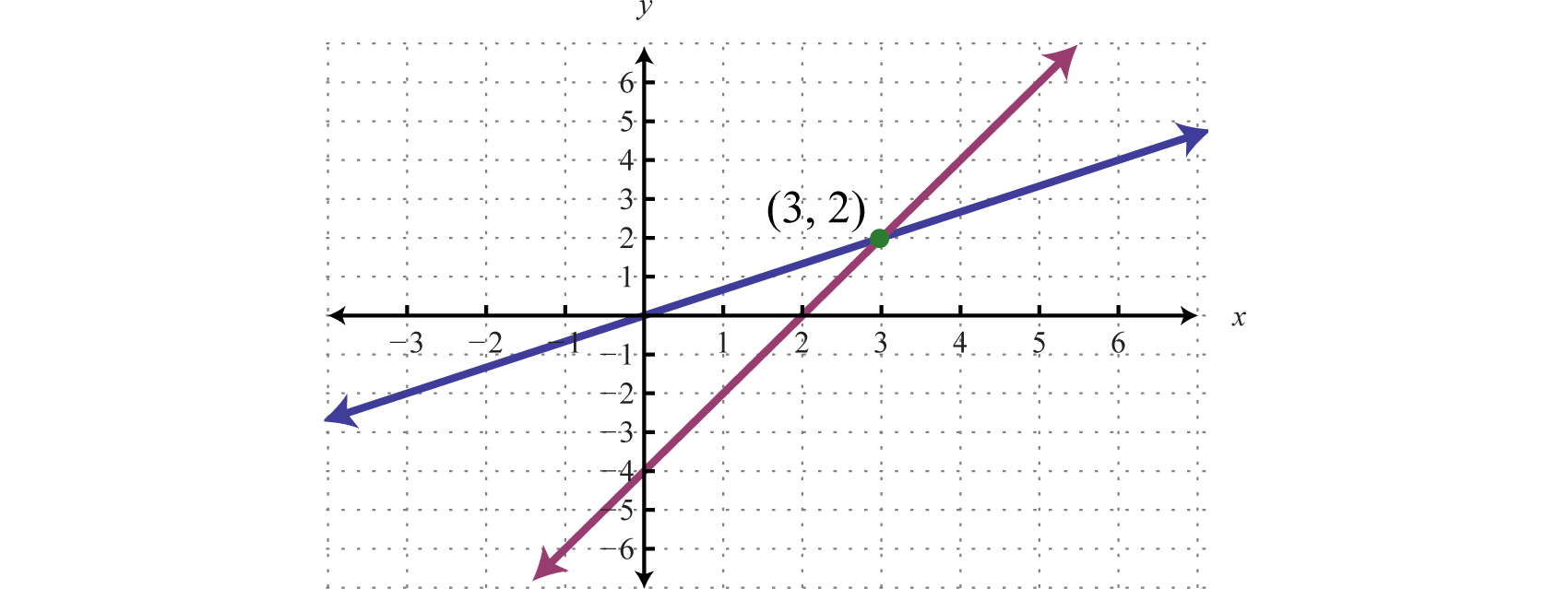
To summarize, linear systems described in this section consist of two linear equations each with two variables. A solution is an ordered pair that corresponds to a point where the two lines intersect in the rectangular coordinate airplane. Therefore, i way to solve linear systems is by graphing both lines on the same set of axes and determining the point where they cross. This describes the graphing methodA means of solving a system by graphing the equations on the same gear up of axes and determining where they intersect. for solving linear systems.
When graphing the lines, have care to choose a good scale and employ a straightedge to depict the line through the points; accurateness is very important here.
Instance two
Solve by graphing: .
Solution:
Rewrite the linear equations in gradient-intercept form.
|
|
|
Write the equivalent system and graph the lines on the same set of axes.
|
|
|
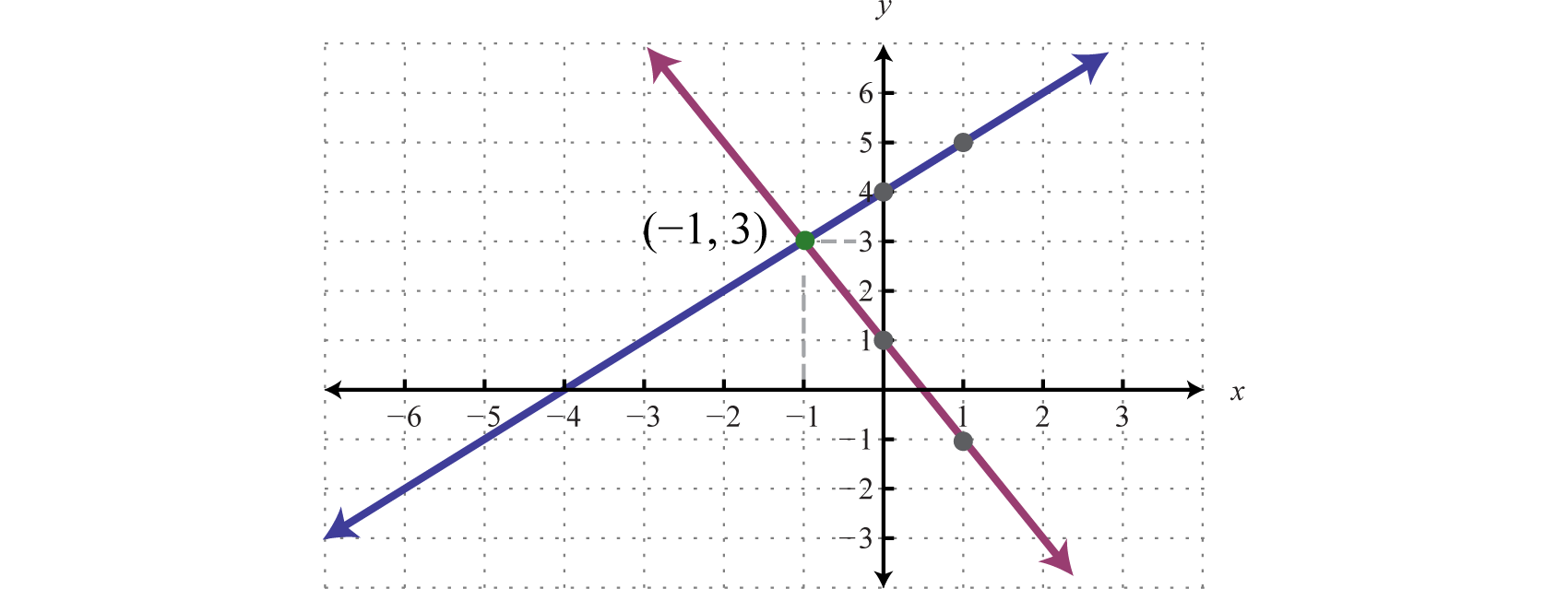
Utilise the graph to approximate the point where the lines intersect and bank check to see if it solves the original arrangement. In the above graph, the point of intersection appears to be (−1, 3).
| Cheque: (−1, 3) | |
|---|---|
| Line ane: | Line 2: |
|
|
|
Answer: (−1, 3)
Example 3
Solve past graphing: .
Solution:
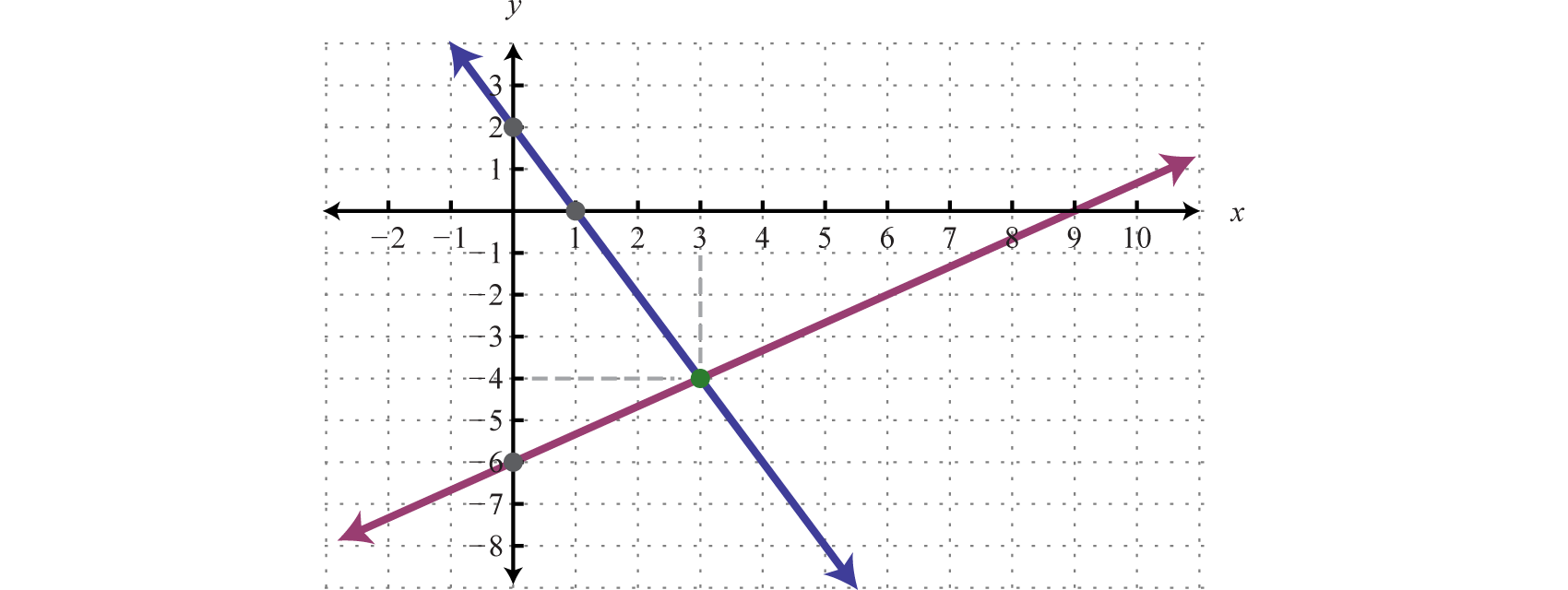
We offset solve each equation for y to obtain an equivalent system where the lines are in slope-intercept form.
Graph the lines and decide the point of intersection.
| Check: (3, −4) | |
|---|---|
|
|
|
Answer: (3, −iv)
Example 4
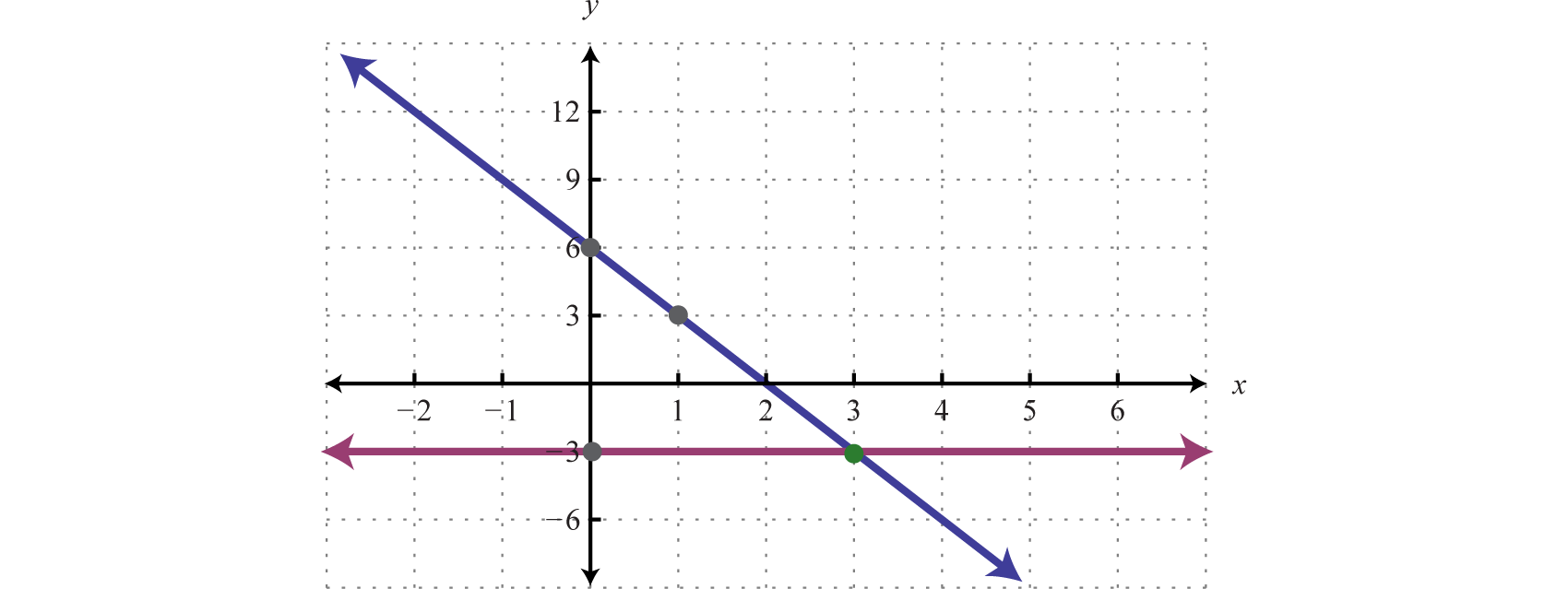
Solve by graphing: .
Solution:
| Check: (3, −3) | |
|---|---|
|
|
|
Answer: (3, −3)
The graphing method for solving linear systems is non ideal when a solution consists of coordinates that are not integers. There volition be more than authentic algebraic methods in sections to come, only for now, the goal is to understand the geometry involved when solving systems. It is important to remember that the solutions to a system correspond to the point, or points, where the graphs of the equations intersect.
Try this! Solve by graphing: .
Answer: (−2, 4)
Dependent and Inconsistent Systems
A arrangement with at least i solution is called a consistent arrangementA organization with at least 1 solution. . Up to this point, all of the examples have been of consistent systems with exactly one ordered pair solution. It turns out that this is not always the case. Sometimes systems consist of two linear equations that are equivalent. If this is the case, the two lines are the same and when graphed will coincide. Hence, the solution set consists of all the points on the line. This is a dependent organisationA linear system with two variables that consists of equivalent equations. It has infinitely many ordered pair solutions, denoted by . . Given a consequent linear arrangement with two variables, in that location are two possible results:

A solution to an contained organisationA linear system with two variables that has exactly one ordered pair solution. is an ordered pair (x, y). The solution to a dependent system consists of infinitely many ordered pairs (ten, y). Since any line can be written in slope-intercept course, , nosotros can express these solutions, dependent on x, every bit follows:
In this text we will express all the ordered pair solutions in the shortened class , where x is any existent number.
Instance five
Solve past graphing: .
Solution:
Make up one's mind slope-intercept grade for each linear equation in the system.
|
|
|
In slope-intercept course, we can easily see that the organisation consists of two lines with the same slope and same y-intercept. They are, in fact, the same line. And the system is dependent.
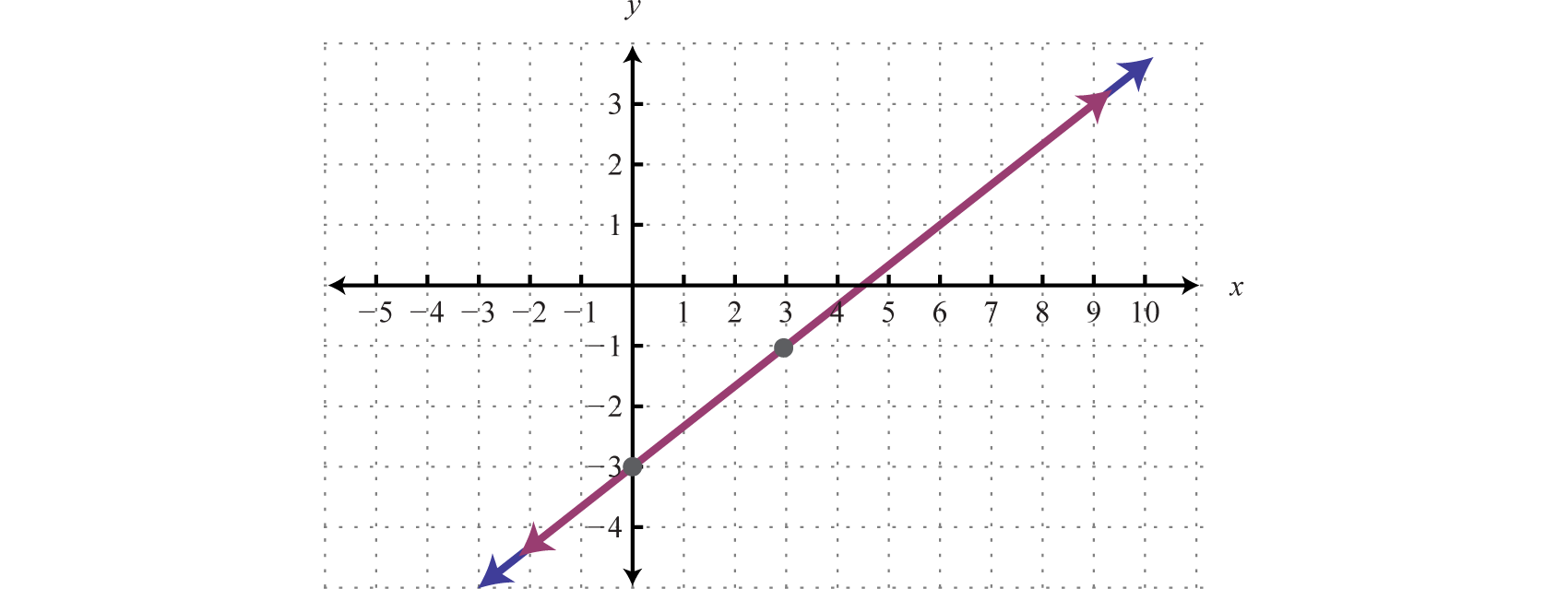
Reply:
In this example, information technology is important to observe that the two lines have the same slope and aforementioned y-intercept. This tells usa that the two equations are equivalent and that the simultaneous solutions are all the points on the line . This is a dependent system, and the infinitely many solutions are expressed using the form . Other resources may express this gear up using gear up note, {(x, y) | }, which reads "the prepare of all ordered pairs (10, y) such that ."
Sometimes the lines exercise not cross and at that place is no point of intersection. Such a system has no solution, Ø, and is chosen an inconsistent systemA system with no simultaneous solution. .

Instance 6
Solve by graphing: .
Solution:
Determine slope-intercept form for each linear equation.
|
|
|
In slope-intercept form, we can easily see that the system consists of two lines with the same slope and unlike y-intercepts. Therefore, the lines are parallel and will never intersect.
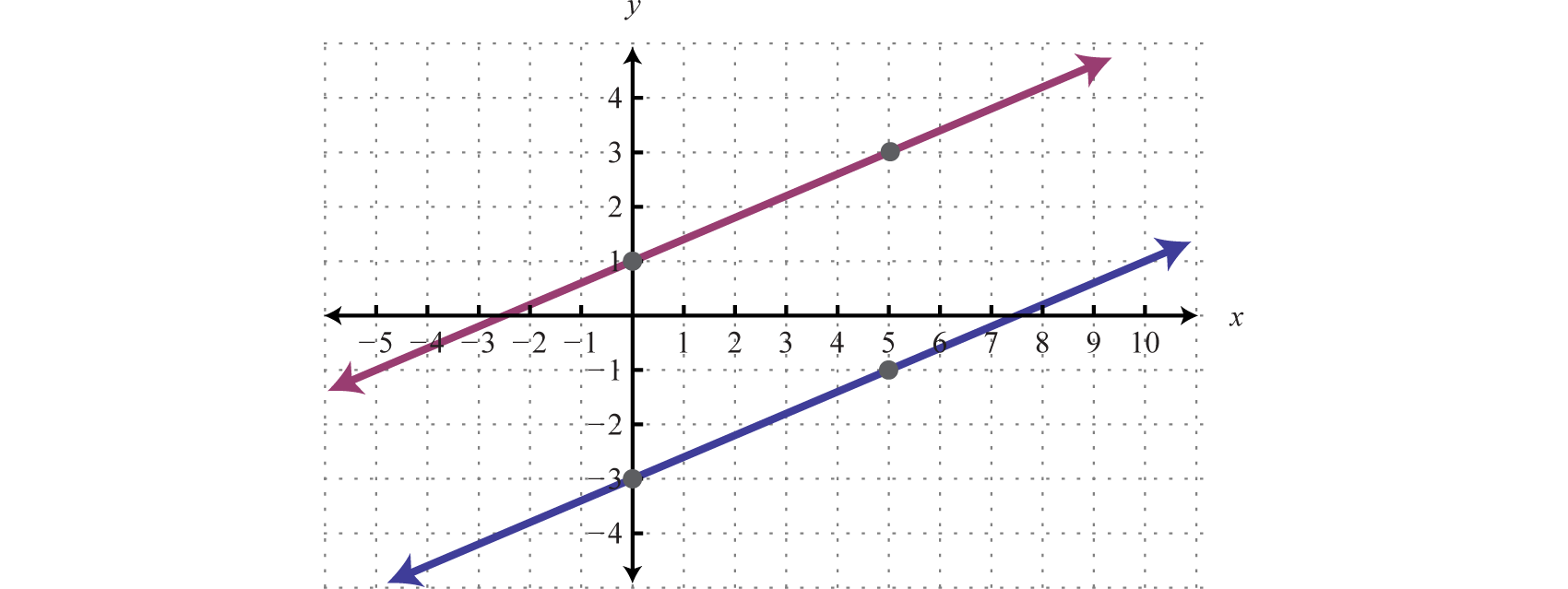
Respond: There is no simultaneous solution, Ø.
Try this! Solve by graphing: .
Answer:
Key Takeaways
- In this department, we limit our study to systems of 2 linear equations with two variables. Solutions to such systems, if they exist, consist of ordered pairs that satisfy both equations. Geometrically, solutions are the points where the graphs intersect.
- The graphing method for solving linear systems requires u.s. to graph both of the lines on the same set of axes as a means to determine where they intersect.
- The graphing method is not the well-nigh authentic method for determining solutions, particularly when a solution has coordinates that are not integers. It is a good practice to always check your solutions.
- Some linear systems take no simultaneous solution. These systems consist of equations that represent parallel lines with different y-intercepts and do not intersect in the plane. They are called inconsistent systems and the solution fix is the empty set, .
- Some linear systems have infinitely many simultaneous solutions. These systems consist of equations that are equivalent and represent the same line. They are chosen dependent systems and their solutions are expressed using the annotation , where 10 is any existent number.
Topic Exercises
-
(−ii, −6);
-
(ii, −7);
-
(0, −3);
-
;
-
;
-
(−3, four);
-
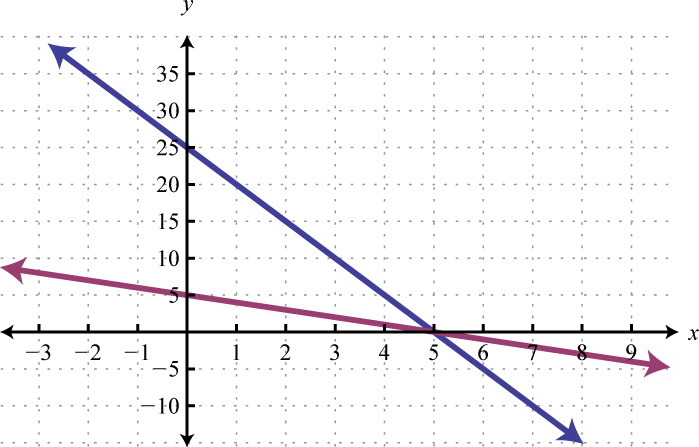
-
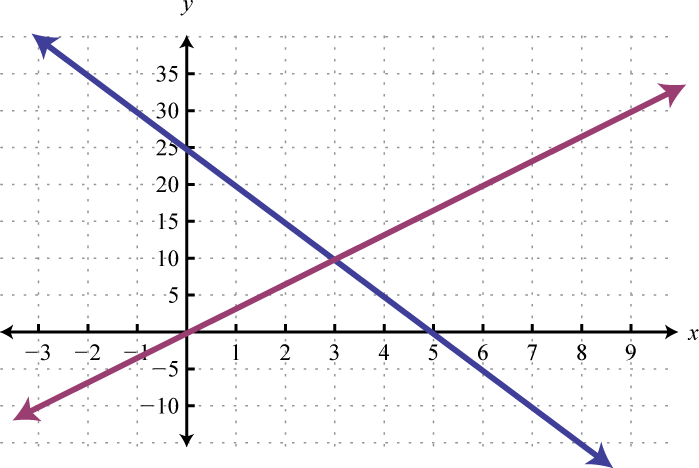
-
-
-
-
-
-
-
-
Office A: Definitions
Determine whether or non the given ordered pair is a solution to the given system.
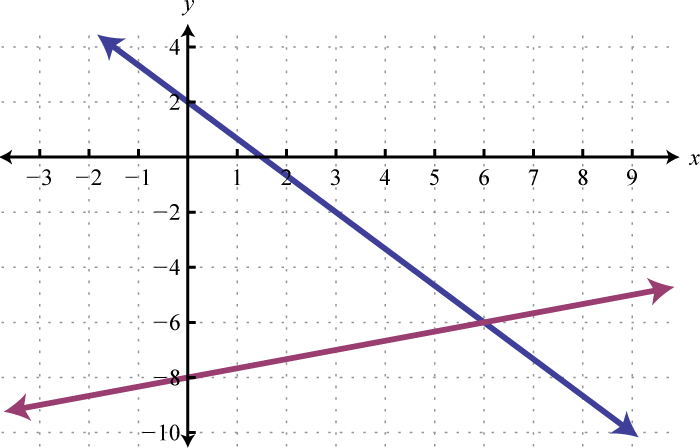
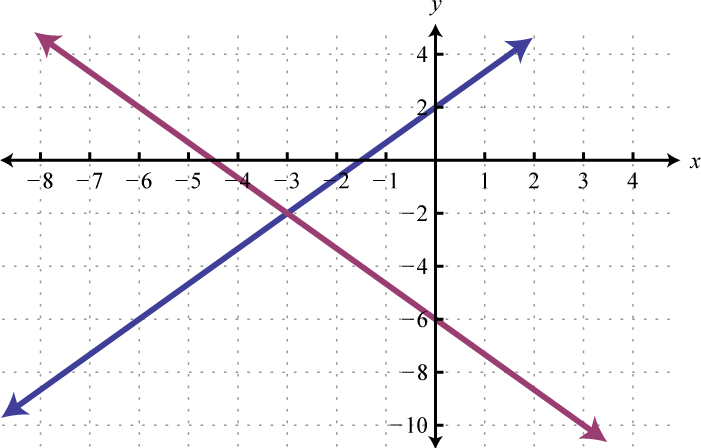
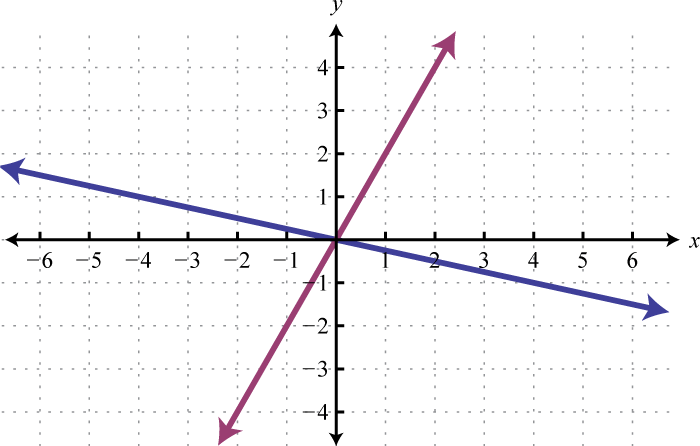
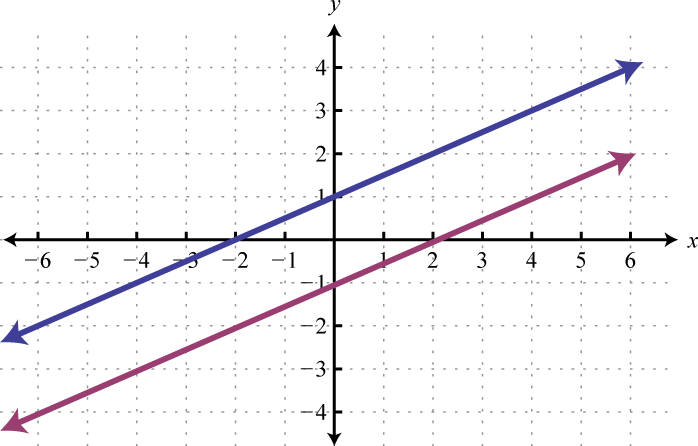
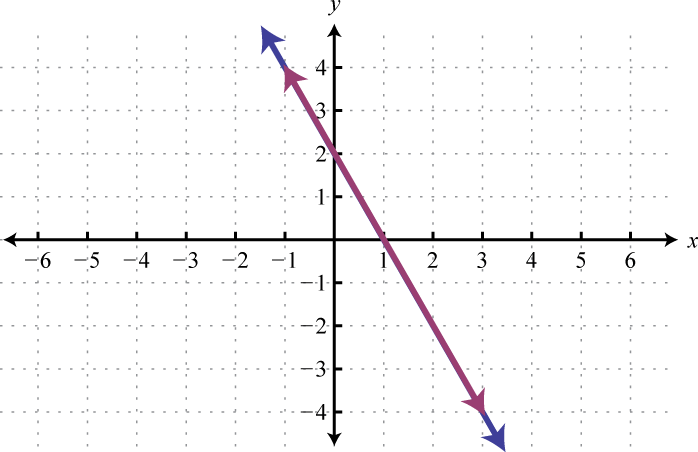
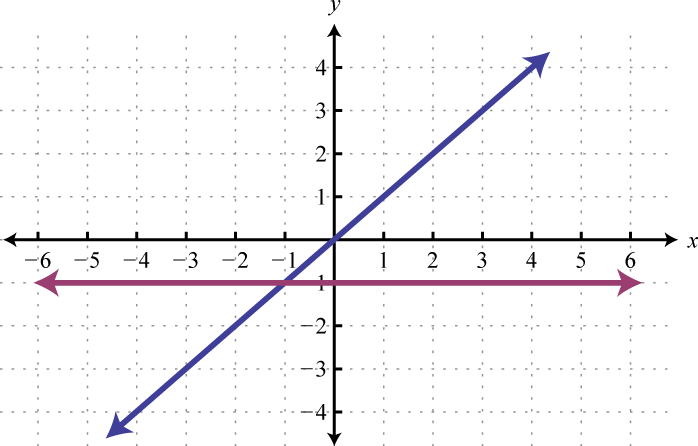
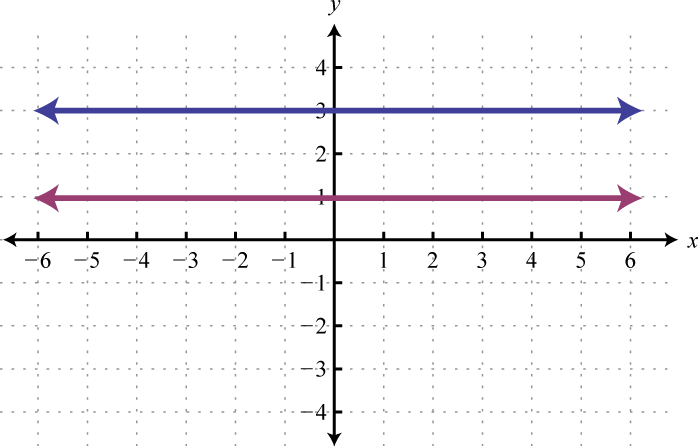
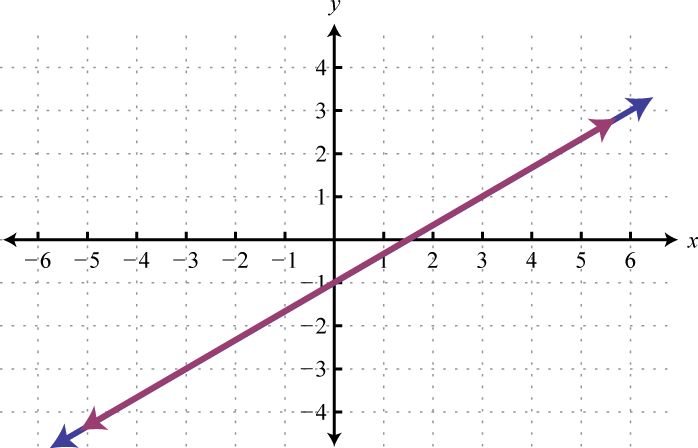
Given the graphs, determine the simultaneous solution.
-
-
-
-
-
-
-
-
-
-
-
-
-
-
-
-
-
-
-
-
-
-
-
-
-
-
-
-
-
-
-
-
-
-
-
-
-
-
-
-
-
Assuming one thousand is nonzero solve the system:
-
Assuming b is nonzero solve the organisation:
-
Find the equation of the line perpendicular to and passing through . Graph this line and the given line on the same set of axes and determine where they intersect.
-
Find the equation of the line perpendicular to and passing through . Graph this line and the given line on the aforementioned set of axes and make up one's mind where they intersect.
-
Find the equation of the line perpendicular to and passing through . Graph both lines on the same set up of axes.
-
Observe the equation of the line perpendicular to the y-axis and passing through the origin.
-
Use the graph of to decide the 10-value where . Verify your answer using algebra.
-
Use the graph of to determine the x-value where . Verify your reply using algebra.
Part B: Solve past Graphing
Solve past graphing.
-
Talk over the weaknesses of the graphing method for solving systems.
-
Explain why the solution ready to a dependent linear organisation is denoted by .
-
Describe a moving-picture show of a dependent linear arrangement equally well equally a picture of an inconsistent linear system. What would you demand to decide the equations of the lines that you have drawn?
Part C: Discussion Lath Topics
Answers
-
No
-
No
-
Yes
-
No
-
Aye
-
(5, 0)
-
(6, −6)
-
(0, 0)
-
-
-
(−two, 3)
-
(3, −i)
-
(five, 3)
-
(−3, −2)
-
(10, 0)
-
-
(three, 4)
-
(−3, −five)
-
(half dozen, 2)
-
-
-
(2, −3)
-
(10, 5)
-
(−nine, half dozen)
-
-
(−5, four)
-
(0, 0)
-
-
-
-
-
;
-
-
-
Answer may vary
-
Answer may vary
Source: https://saylordotorg.github.io/text_intermediate-algebra/s06-01-linear-systems-with-two-variab.html
0 Response to "the tables represent two linear functions in a system. what is the solution to this system"
Postar um comentário